



An ND filter, similar to a car’s window tint, is a darkened piece of glass or resin that limits the light entering a camera lens. It’s essentially used to control the amount of light reaching the lens, but it’s important to note that no ND filter is completely opaque; all types allow at least a small amount of light through.
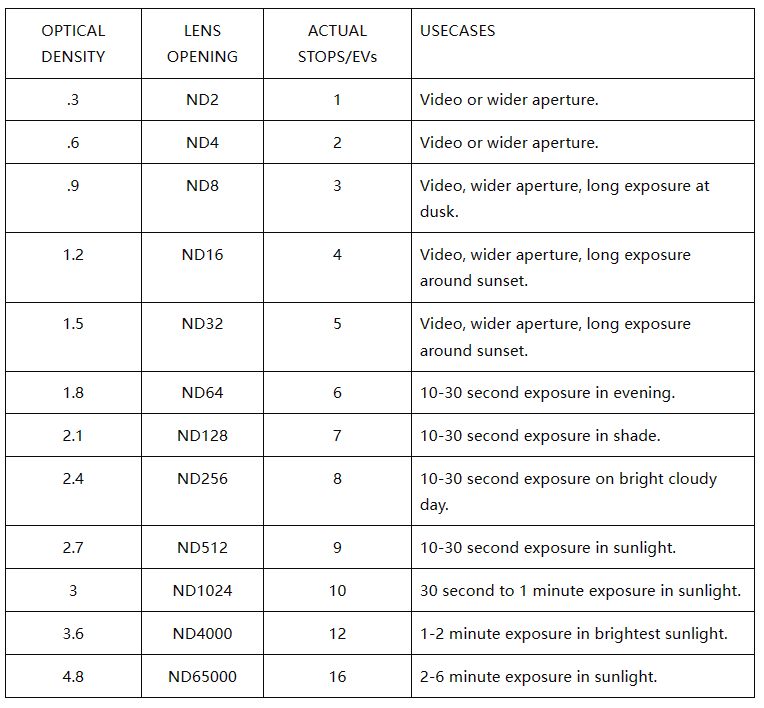
The strength of an ND filter, referred to as its density, varies. Some filters might block half of the incoming light, while others might block up to 99%. The density of an ND filter is measured in three ways: Optical Density, Lens Opening, and Stop Value. A handy chart can be used to understand how these different measurements correlate, which is useful when shopping for ND filters.
Most ND filters are threaded and screw directly onto a lens. They come in standardized sizes to match those used by lens manufacturers. Alternatively, some ND filters are designed for filter holder systems, which can be more cost-effective and versatile across different lenses. These systems usually come in 100mm and 150mm sizes and can either screw onto the lens or attach via a custom harness.
It’s important to distinguish between true ND filters and variable ND filters. True ND filters absorb light uniformly across the scene, while variable ND filters use polarization effects that can lead to color distortions and uneven brightness.
The ‘neutral’ in neutral density signifies that these filters aim to evenly reduce light across all visible light frequencies. However, achieving perfect neutrality is challenging, and some color cast is common in images taken with ND filters. This can usually be corrected in post-processing software like Lightroom.
Photographers use ND filters for both technical and creative reasons, although they’re not always essential. For instance, they’re crucial for photographing extremely bright scenes, like the sun, to prevent damage to the camera sensor or film. Creatively, ND filters can blur motion in a scene or allow for wide-open apertures in bright conditions.
In outdoor lighting with strobes, ND filters help manage flash sync speed issues. Most cameras have a flash sync limit around 1/200 – 1/250th of a second, which is too slow in bright sunlight. An ND filter can reduce exposure to sync the flash properly while maintaining the correct exposure.
Photography often revolves around increasing light in images, but ND filters are essential when the goal is to reduce light entering the lens. They offer a unique solution for various lighting challenges faced by photographers.