



Camera technology has significantly evolved since Nikon introduced its F mount in 1959, a mount still in use in Nikon’s DSLR range today. However, the technology within the mount has changed over time. Modern Nikon F mount lenses, for example, have electronically controlled apertures, a feature Canon cameras have had for years. Older Nikon cameras don’t support these electronic apertures, and the latest F mount lenses with electronic features like USM motors and VR stabilizers don’t fully function on Nikon’s last film camera bodies. In contrast, Canon’s newest EF lenses are still compatible with all EF camera bodies, including EF film bodies, making the Canon system more straightforward and versatile.
Nikon’s F mount presents challenges for current Z mount camera users, as they can’t readily use many older Nikon DSLR and SLR lenses. Meanwhile, Canon users have access to a vast array of EF lenses. Nikon has attempted to modernize the F mount by removing features like the screw drive in some of their latest DSLRs, favoring USM-style autofocus lenses. Despite these efforts, Nikon has significantly reduced its production of DSLR cameras and many F mount lenses.
The issue with Nikon’s F mount began with their introduction of autofocus lenses. Instead of changing the lens mount, Nikon added a screw drive mechanism to the F mount for autofocus, but this design limits compatibility with Z mount cameras, which don’t have a built-in screw drive motor.
Nikon’s Z mount is designed for modern lenses with USM motors, similar to Canon’s RF mount, but lacks the backward compatibility that Canon offers with its RF and EF mounts. As a result, most Nikon F mount lenses with autofocus won’t work on newer Z mount cameras or newer Nikon DSLRs lacking the screw drive.
However, Nikon F lenses with the AF-S designation, which use internal USM motors, are compatible with Z mount cameras using an adapter. The fundamental difference in design between F and Z mounts is due to the mirrorless structure of Z mount cameras, which don’t require a mirror box and have a reduced back focus distance.
Older F mount lenses also vary in how they actuate the lens aperture, with many transitioning from mechanical to electronic but still relying on the screw mount autofocus system. Only the latest fully electronic F mount lenses are compatible with Nikon Z mount cameras via the Nikon FTZ adapter.
For collectors of vintage Nikon film cameras, adapting older lenses to newer cameras or vice versa can be complex. The Z mount, with its larger diameter (55mm) compared to the F mount (47mm), further complicates the compatibility of older screw drive lenses with new Z mount cameras.
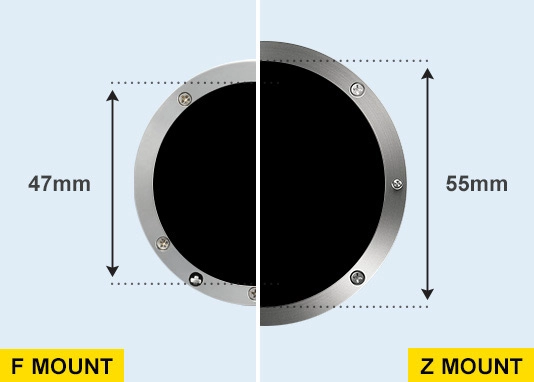
While the lack of backward compatibility is a challenge for Nikon, especially as they compete with Sony, Canon, and other mirrorless camera brands, the modern Z mount ensures that all Z mount lenses will function flawlessly on Z mount cameras for the foreseeable future. The larger size of the Z mount also facilitates the design of large aperture lenses, like the 58mm f/0.95.
Despite these advancements, Nikon seems to be shifting away from the F mount in favor of the Z mount, as the camera market increasingly favors mirrorless technology. Nikon’s serious focus on the Z mount suggests a future where F mount might become obsolete. Nikon’s use of Sony sensors and collaboration with Tamron and Sigma for Z mount lenses raises questions about Nikon’s capacity to maintain two systems and its unique value proposition compared to Sony cameras.
Ultimately, Nikon’s commitment to the Z mount indicates a significant strategic shift. The company may find it challenging to compete with Canon and Sony, and there’s a possibility that Nikon could transition to becoming a third-party lens manufacturer, focusing on the lenses they’ve developed for other camera mounts. This shift reflects the changing dynamics in the camera industry, where Nikon’s legacy in film cameras may evolve into a new role in the digital age.